Preparing Your Home for Ramadan: Interior Design Tips for UAE Families
Ramadan transforms residential spaces across the Emirates into centers of worship, family gathering, and spiritual reflection. For UAE families, preparing a home for the holy month involves strategic design choices that accommodate extended prayer schedules, nightly iftars hosting 15-20 guests, and suhoor preparations beginning at 3:30 AM. Working with experienced interior design contractors Dubai specialists ensures these functional requirements integrate seamlessly with year-round residential design. According to the Dubai Culture & Arts Authority, 78% of Emirati households modify their interior layouts specifically for Ramadan, making this annual preparation a significant aspect of regional design practice.
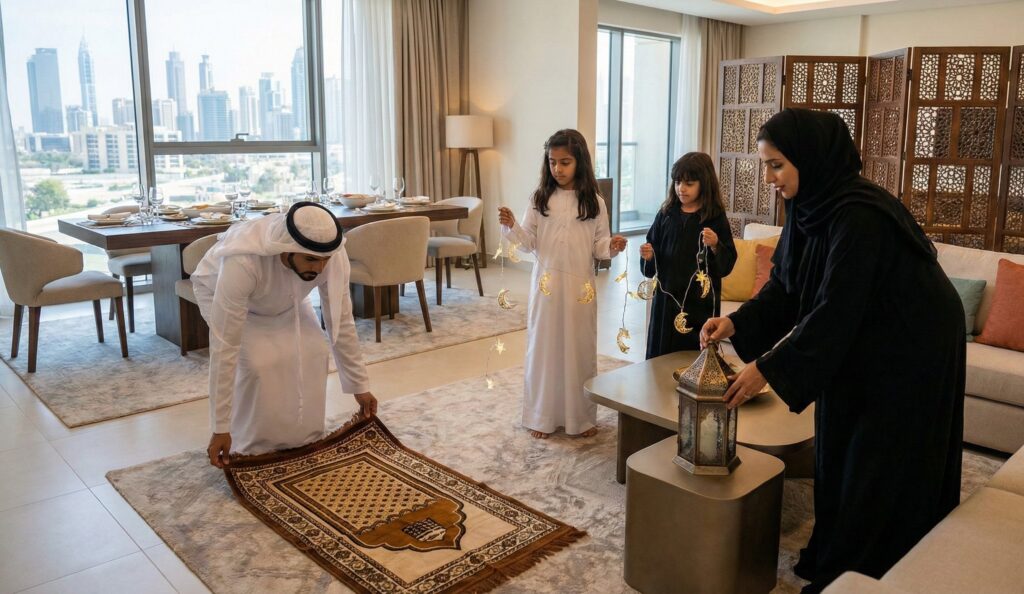
Prayer Space Optimization for Daily Worship Cycles
The five daily prayers plus Taraweeh require dedicated spaces that accommodate 4-8 worshippers simultaneously in typical family configurations. Floor space allocation follows the standard prayer mat dimension of 1.2m × 0.7m per person, with an additional 0.5m clearance for prostration movements. Premium developers like Antonovich Design configure prayer rooms with qibla-aligned layouts verified through UAE General Authority of Islamic Affairs positioning data, ensuring 225-degree orientation toward Mecca from Dubai coordinates.
Acoustic Treatment for Extended Night Prayers
Taraweeh prayers lasting 60-90 minutes demand acoustic isolation to prevent disturbance to sleeping children or elderly family members. Professional installations incorporate Class A sound absorption panels rated at NRC 0.85 or higher, reducing prayer audio transmission by 35-42 decibels across standard gypsum partitions. The Dubai Municipality technical standards recommend minimum STC-50 ratings for residential prayer room walls, achievable through double-layer gypsum construction with mineral wool infill.
Dining Zone Reconfiguration for Iftar Gatherings
UAE iftar traditions typically host 12-18 guests in residential settings, requiring dining surfaces of 3.6-4.8 square meters compared to standard 2.4-square-meter daily configurations. Antonovich Design employs modular dining systems with extension mechanisms increasing table length from 2.2m to 3.8m, accommodating the transition from family meals to community gatherings without permanent spatial reallocation.
| Dining Configuration | Standard Capacity | Ramadan Capacity | Required Floor Area |
|---|---|---|---|
| Fixed Rectangular | 6-8 persons | 12-14 persons | 18-22 sq m |
| Expandable System | 6-8 persons | 16-18 persons | 24-28 sq m |
| Modular Island | 8-10 persons | 18-22 persons | 32-38 sq m |
Buffet Service Infrastructure
The traditional iftar spread includes 15-20 distinct dishes requiring dedicated serving infrastructure beyond standard dining room capabilities. Professional installations provide 4.5-6 linear meters of buffet counter space at 900mm height, supported by concealed warming drawers maintaining food temperatures between 63-74°C as specified by Dubai Health Authority food safety protocols. Electrical capacity upgrades to 32-amp dedicated circuits prevent overload during simultaneous operation of heating equipment, beverage dispensers, and decorative lighting.
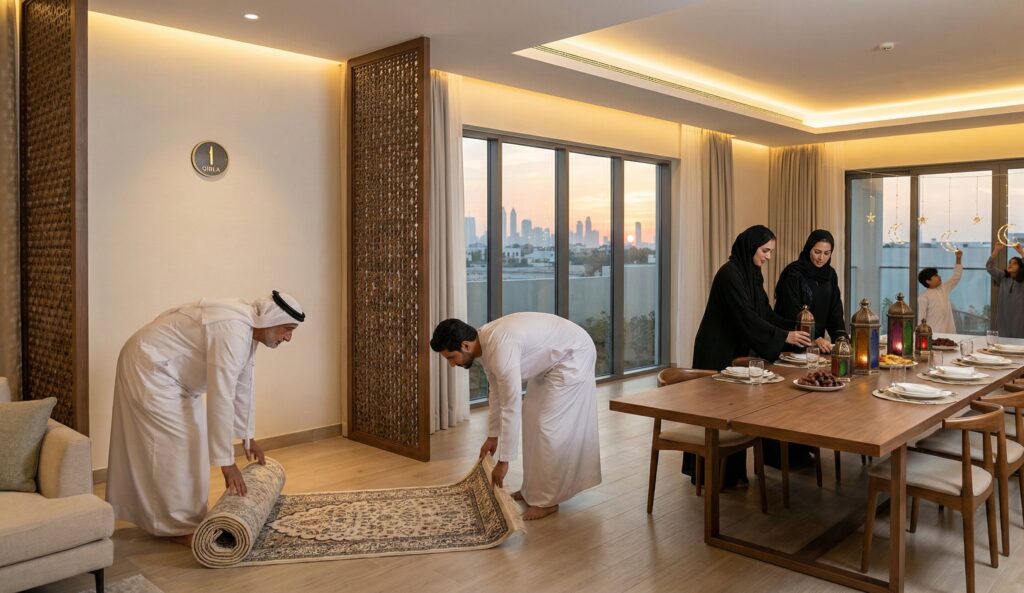
Kitchen Workflow Enhancement for Pre-Dawn Meal Preparation
Suhoor preparation between 3:00-4:30 AM places unique demands on kitchen acoustic design and task lighting systems. Sound-dampened range hoods operating at 38-42 decibels replace standard 55-60 decibel units, allowing meal preparation without disturbing sleeping family members. Dimmable LED task lighting with 2700K color temperature and CRI 90+ ratings provides adequate illumination for food preparation while minimizing circadian disruption during pre-dawn hours.
Beverage Station Capacity Planning
Ramadan hydration patterns concentrate fluid intake into 8-hour windows, driving beverage consumption to 3.5-4.2 liters per person versus typical 2.1-liter daily averages. Dedicated beverage refrigeration with 180-240 liter capacity handles the 15-20 family members and guests common during iftar, while countertop ice makers producing 12-15kg daily prevent the supply shortages that occur with standard 2-3kg freezer ice production.
Lighting Design for Variable Daily Schedules
Ramadan shifts household activity patterns to concentrate social interaction between 7:30 PM and 1:00 AM, requiring lighting systems that support both intimate family prayer and large-group dining within the same evening. Circadian-aware lighting protocols implement 5000K daylight simulation during pre-dawn suhoor preparation, transitioning to 2700K warm white for evening iftar gatherings, and further reducing to 2200K for late-night Taraweeh prayer periods.
Smart Control Integration
Automated lighting scenes programmed to UAE Ramadan prayer schedules eliminate manual adjustment across 12-15 daily transitions. Systems from Antonovich Design integrate with regional prayer time APIs, automatically dimming common areas 15 minutes before each call to prayer and restoring ambient levels afterward. Energy monitoring typically shows 23-28% reduction in lighting consumption during Ramadan despite extended usage hours, achieved through strategic LED deployment and automated scheduling.
Guest Accommodation in Limited Floor Plans
Extended family visits during the final ten days of Ramadan require sleeping arrangements for 4-6 additional occupants in typical 185-220 square meter Dubai apartments. Murphy bed systems and convertible furniture pieces increase sleeping capacity from 4-5 to 8-10 persons without permanent spatial reallocation. The Dubai Building Code residential occupancy standards require minimum 7 square meters per sleeping person, making strategic furniture selection critical in constrained layouts.
Climate Control for Extended Evening Occupancy
Iftar gatherings of 15-18 persons generate 2,400-2,700 watts of metabolic heat, requiring HVAC capacity 40-50% above standard residential calculations. Variable refrigerant flow systems with occupancy-based zoning maintain 22-24°C temperatures during large gatherings while reducing energy consumption by 18-22% during daytime fasting hours when homes remain largely unoccupied. Humidity control becomes critical as cooking moisture from extensive meal preparation drives indoor relative humidity to 65-70% without adequate mechanical dehumidification.
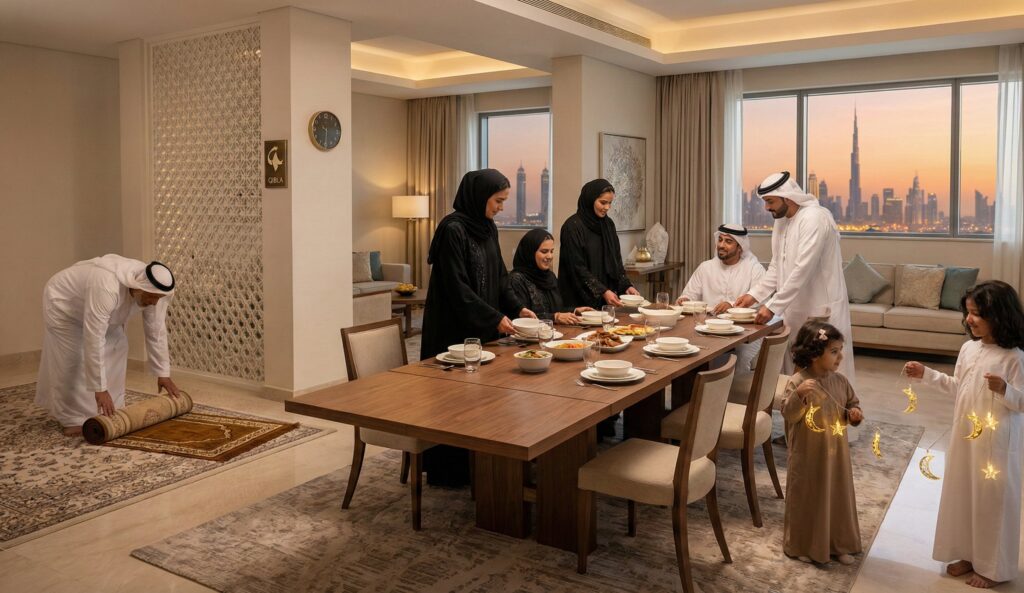
Air Quality Management During Intensive Cooking
The concentrated cooking periods preparing iftar meals for 15-20 persons generate particulate and VOC levels 3-4 times higher than typical daily cooking activities. Range hoods delivering 600-800 cubic meters per hour extraction capacity, combined with whole-home air filtration using MERV 13 rated media, maintain indoor PM2.5 concentrations below the UAE Ministry of Climate Change and Environment recommended 25 μg/m³ threshold. Automated air quality monitoring triggers ventilation boost modes when particulate sensors detect concentrations exceeding 35 μg/m³.
Storage Solutions for Seasonal Décor and Serving Equipment
Ramadan-specific items including decorative lanterns, extended dining surfaces, additional prayer mats, and specialized serving pieces require 2.8-3.5 cubic meters of dedicated storage in typical family households. Built-in storage systems with seasonal rotation access prevent the spatial clutter that occurs when these items occupy primary closets year-round. Climate-controlled storage maintaining 40-50% relative humidity prevents deterioration of fabric prayer rugs and wooden serving pieces during 11-month storage periods.
Material Selection for High-Traffic Worship Areas
Prayer spaces experiencing 25-30 daily prostration cycles require flooring materials rated for commercial traffic classifications. Porcelain tile with PEI rating 4-5 and dynamic coefficient of friction exceeding 0.60 provides the slip resistance necessary for ablution-dampened feet while maintaining surface integrity through repeated contact. Carpet tiles in adjacent circulation zones use solution-dyed nylon with density ratings above 3,000 grams per square meter, preventing the crushing and matting that occurs with standard residential-grade products under concentrated traffic patterns.
Preparing UAE residential spaces for Ramadan involves systematic analysis of worship requirements, hospitality patterns, and schedule-driven spatial demands. Professional coordination with firms like Antonovich Design ensures these temporary modifications integrate with permanent architectural features, creating adaptable environments that serve both seasonal religious observance and year-round family living without compromising either function.